
part of anamnesis | Luisa do Amaral, Cyan D’Anjou, Wonjae Lee
“Things of Boundaries: a Case Study of Interdisciplinarity” is an ongoing study on different ideas of interdisciplinarity and different professional and academic trajectories of Founding Lab students, fellows and staff members. We investigate how different actors view their own life journeys towards working in interdisciplinary settings, and hypothesise how their views reveal their social position, and whether we find radically different ideas of what interdisciplinarity is. In progress.
Objective: to build a record of the Founding Lab, one that serves to capture the richness of our experience, but which also serves as a report of the different dispositions of those involved in stitching IT:U together, in a way that archives, for the future of the university, a picture of the often invisible conditions of its foundation.
Tentative Abstract: Centuries, millenia before the word “interdisciplinarity” became part of the everyday vocabulary of the production of knowledge, the first thinkers and scholars weren’t strictly confined to disciplinary boundaries. The naming of a discipline eclipses the fact that different individuals, who self-identify as practitioners or not, will conceive its frontiers in widely differing terms, and the existence of the boundaries of a thing seems to beget the existence of things to bound. However, a non-linear approach to the historical process of the emergence of disciplines will show us that there aren’t in fact any entities, rather just sites of difference, and the loose idea of consensus that enables different people to agree that certain things should be called by the same name.
The acceleration of supermodernity might make it seem like these cycles of fractal distinctions between inter and intra disciplines are spinning faster and faster, and that Science in the early 21st Century stands firmly at the open edges of everything. In this context, the hybrid researcher has an augmented sense of reality, in which the previously inconceivable dimensions of data became tangible through the power of automated thinking. However, for the most part, cyborg scientists in emerging digital fields must work together, not just with nonhuman collaborators, but also with other fellow augmented scientists. The Digital Sciences consist of multidisciplinary teams, bridging the gaps between the different epistemic cultures that are required to coexist and collaborate in order to make their existence viable. The challenges are diverse, and of different orders; as simple as coordinating different calendars of publications, or managing diverse expectations and irreconcilable differences between the values systems of different practices, or as fundamental as different interpretations of what constitutes “interdisciplinarity” and the nature of their collaborations.
This study aims to reflect on the condition of cyborg scientists in augmented fields, trying to produce new hybrids out of their own chimerism. The site of difference in question is the inception group of the Interdisciplinary Transformation University (IT:U), the new Austrian university, founded in 2022. The methodology focuses on qualitative analysis of perceptions, conventions and experiences related to interdisciplinarity, through interviews with the founding convent and staff. Furthermore, as a student of the Founding Lab, the prototype first semester of the new university, I will also analyse feedback forms and conduct interviews with other students involved in the project, as well as my own perceptions throughout the process. By uncovering how the individual level and its connection to a perception of whole might influence collaborative processes, we seek to contribute to better practices in interdisciplinary academic settings.
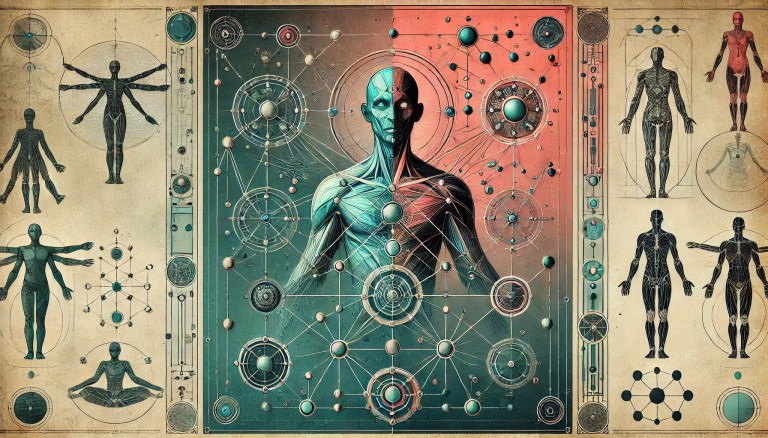
featured image generated with DALL-E, based on the abstract.
>> back to anamnesis
 Corvo Correio | the Raven Post